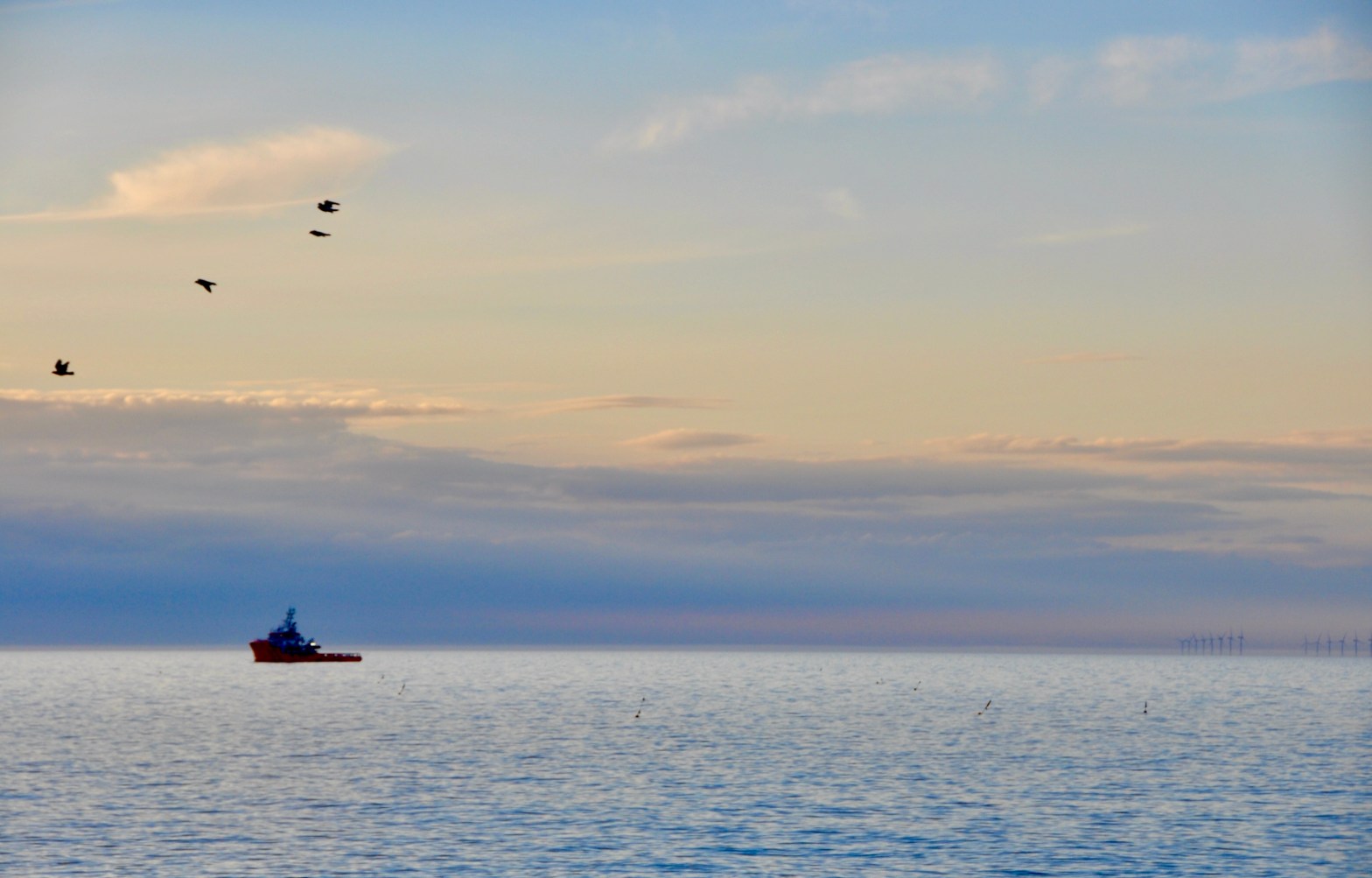
from Sheringham beach
gazing out to Sea.…..searching
for Doggerland
Looking out to sea, from the shoreline along the Norfolk and Suffolk coast, there is nothing moving, except for the occasional ship and the ghostly outlines of distant windmill farms, as far as the eye can see.

The rest is a vast empty expanse of ocean. But, as you look out, imagine that this area of the North Sea was once an enormous land mass stretching out to Holland and Germany, all the way up to Scandinavia, where for the last million years, in between frequent global warming and cooling, hominins have frequented the area.
Picture a landscape that has frequently changed during the millennia, dependent on the climate conditions, from Mammoth steppes, to frozen tundra where vast herds of reindeer roamed. More recently from about 15,000 years ago, with rising temperatures and sea levels, the area became an enormously rich and fertile wetland, full of food, an ideal area for the hunter gatherers who lived here in relatively large numbers. And so it continued, up to the time that the rising sea levels eventually submerged the whole area about 8,000 years ago.
This is the story of a buried treasure trove of collective memory, a place called Doggerland, with a meaning and resonance for us today, in our age of anxiety and man made climate breakdown, a metaphor for loss and perhaps hope.
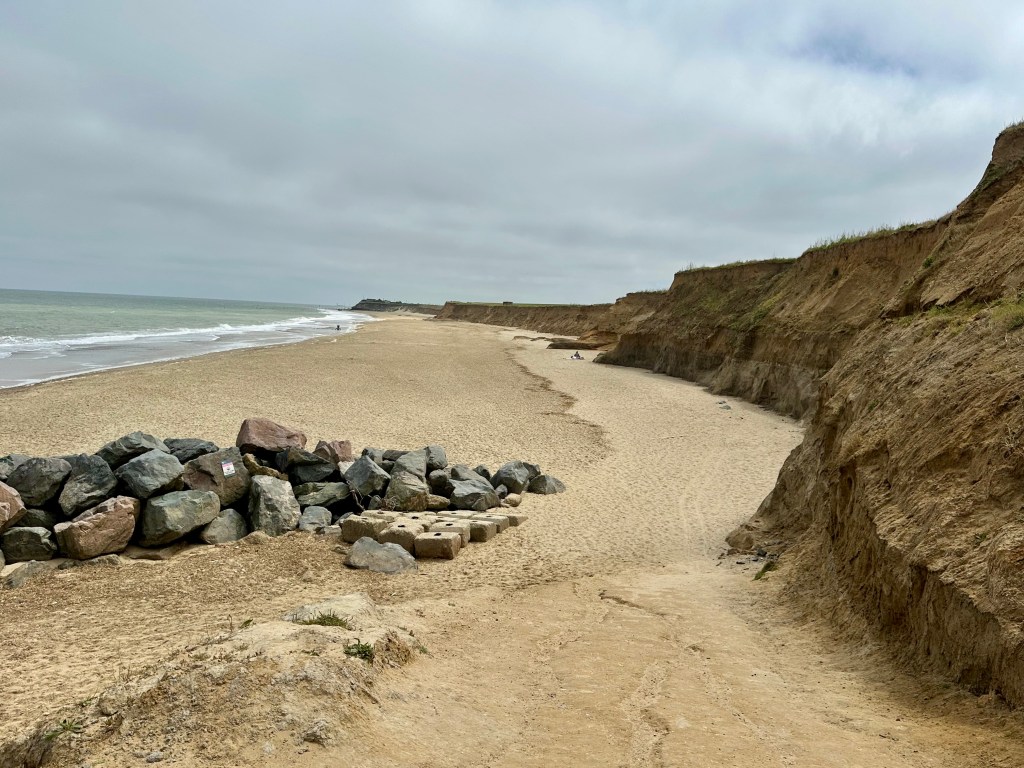
I’m visiting Happisburgh beach in Norfolk trying to imagine life here, nearly a million years ago, during the height of the last ice age, close to where the Thames once flowed. This was one of the many periods of slightly warmer weather as the glaciers receded. It was a land of grassland and pine forests, populated with deer, mammoth and even rhinoceros. And it was here, in this landscape, in 2013 that evidence was found of the first human species to reach the Northern climes.
At that time Homo Sapiens had not yet emerged from Africa, but in 2013 an astonishing discovery was made that one of the earliest human species, ‘Homo Antecessor’, had been walking along our beaches. On this remote Norfolk beach of Happisburgh (pronounced Haze-bruh) in Norfolk, a set of fossilised footprints were discovered that date to the Lower Palaeolithic period around 950–850,000 years ago. They were photographed in 3D before being destroyed by the tide shortly afterwards. Resulting research, identified them as the oldest known hominid footprints outside Africa.
The prints show what appears to be family groups, adults and children walking together. What were their thoughts and how did they live? Speech, as we know it today, was still hundreds of thousands of years away in its evolution, so it is intriguing how they communicated?
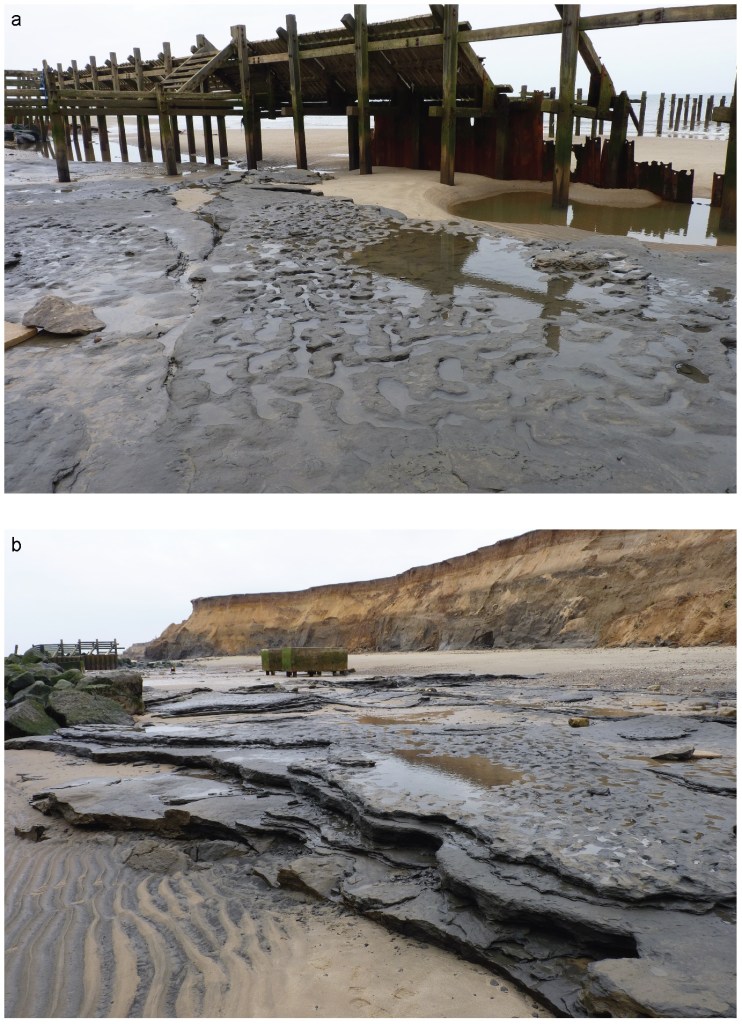
I find the fact that these traces even appeared for a brief time, before disappearing again forever, incredibly moving and poignant, a folk memory of an ancient time.
footprints in the mud
echo down the ages
traces of humanity
Half a million years ago, another human species, ‘Homo Heidelbergensus’ arrived on the scene, just to disappear again 50,000 years later, when life became uninhabitable in Britain for millennia, as a result of the onset of another ice age.
A stunning hand axe carved in black flint, the oldest hand axe ever discovered in North West Europe, was also found in Happisburgh from this period; it had lain there on the foreshore for 500,000 years. This axe shows clearly the intelligence of these early human species, not only is it immensely practical, but it has been carved to bring out the aesthetic qualities of the flint. It is an object of great beauty.
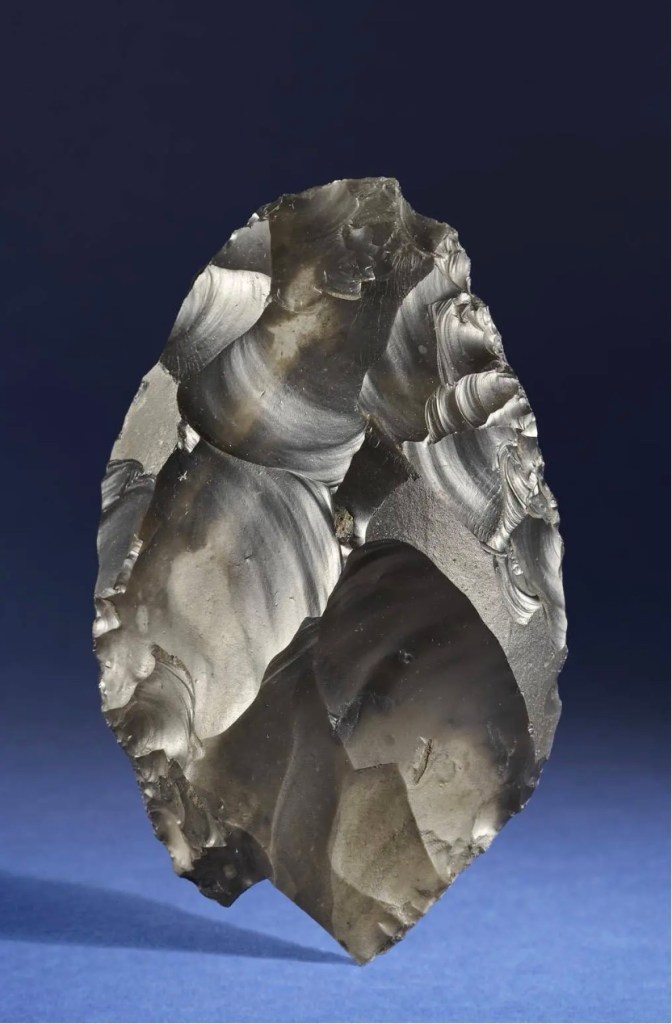
(Rights Holder: Norfolk County Council. Licensed under a Creative Commons Attribution 2.0 Generic License)
Then about 400,000 years ago, our most recent close relatives, the Neanderthals ‘Homo Neanderthalensis’, started visiting the area on and off, through various changing climatic conditions. Neanderthals used to have a bad press, being largely depicted as unthinking brutes, mainly due to their thick eyebrow ridges, making them look slightly ape-like. The truth is that Neanderthals were a highly developed hominin species, equally as intelligent, if not more so, than early Homo Sapiens.
Our own species, ‘Homo Sapiens’ eventually appeared on the scene about 40,000 years ago, but a permanent presence in Britain only commenced about 15,000 to 13,000 years ago, when the most recent ice age ended and the glaciers started melting. This was a period of a rich environment, the age of the hunter gatherers, a fertile landscape of forests together with wetlands and salt marshes, with plentiful food supplies. It was a remarkable place that attracted large numbers of people during this Mesolithic golden age.
They were able to adapt to the unpredictability of the rising waters. To them it was a normal way of living and they changed and moved, as the landscape altered. This way of life continued for many centuries, but the waters still continued to rise. About 8000 years ago, around 6,150 BC, there was a catastrophic event off the coast of Norway called the Storrega landslide, which caused a series of Tsunamis all down the Doggerland area, drowning the landscape. This was the beginning of the end and over the next few centuries, the waters continued to rise as more ice melted, and by about 4,000 BC the last remaining and highest part of Doggerland, the Dogger Bank, disappeared for ever under the North Sea. All that was left was the myth and the legends.
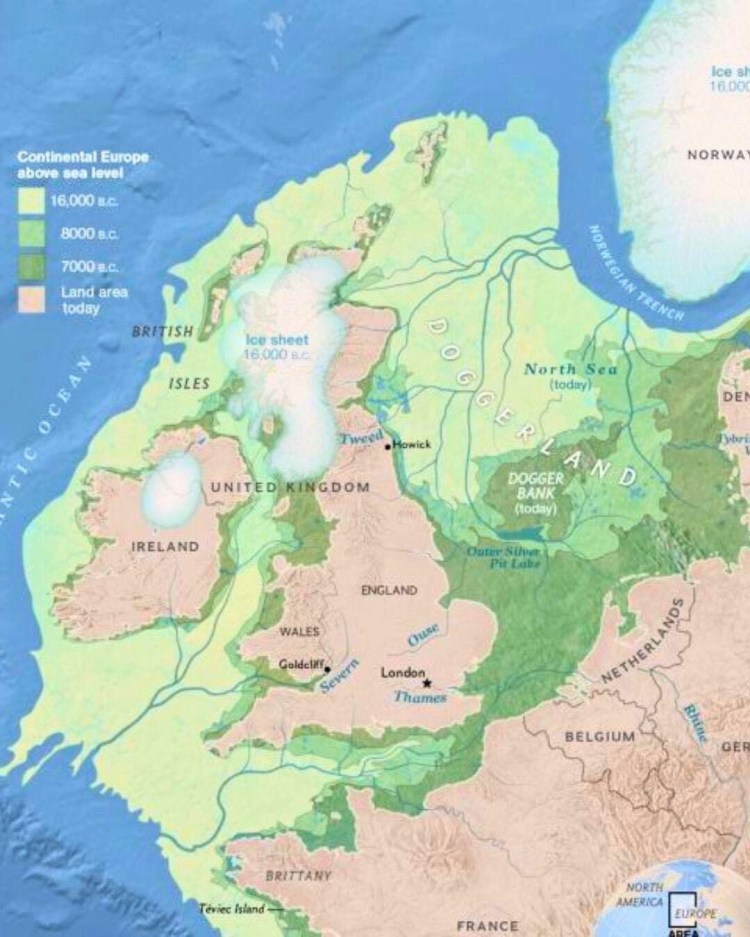
This was also the end of the Mesolithic period and the last of the hunter gatherers. From now on, across Britain and Europe, the Neolithic farmers moved in, migrating from the Middle East and beyond, changing the way of life in this part of the world for ever.
It is worth, at this stage, to reflect on the timescales of prehistory involved, which can be difficult to comprehend. The Stone Age is divided into the Old Stone Age (Palaeolithic), the Middle Stone Age (Mesolithic) and the New Stone Age (Neolithic). Because of the enormous length of the Palaeolithic (from around 3.3 million years ago until 11,000 years ago), it is also divided into 3 eras, Lower, Middle and Upper) – see chart below:-
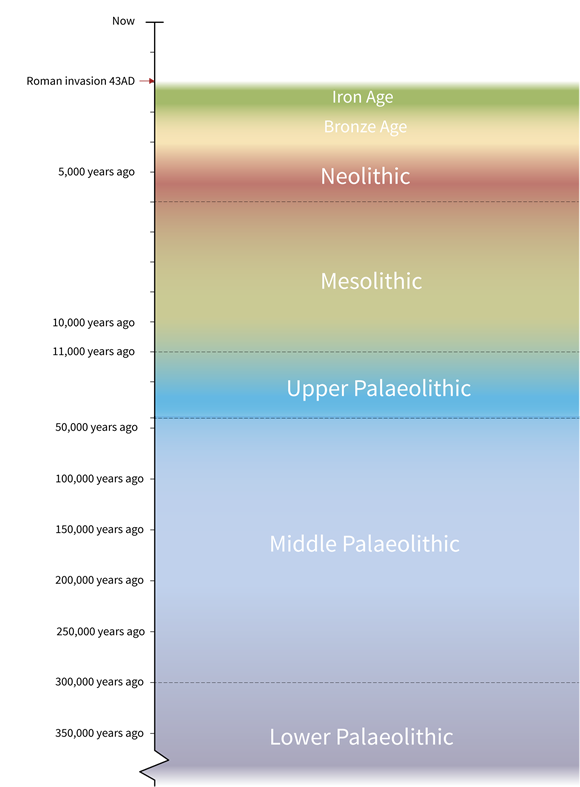
Although, for us humans, this appears to be an enormous period of time, in the context of Deep Time, it is but a nanosecond. If you consider that the Dinosaurs walked the earth up to 65 million years ago, it gives a brief idea of the enormous time scales involved.
The myth of Doggerland had lain dormant for many centuries, but it was not until the 19th century that fishing boats from Holland and England started picking up traces of Doggerland in their nets, often around the Dogger Bank, the highest point in the North sea. Fossils of mammoths, aurochs and other animals had been found over the years, together with bones of humans, and a vast array of tools, building up a picture of continuous occupation over the millennia.
It was not until the 1990s, that this area was studied in more detail. It was given the name Doggerland, by an archeologist called Bryony Coles, named after the Dogger Bank, which in turn had been named after the 17th-century Dutch fishing boats called ‘doggers’.
In 2001 a fishing boat discovered a spectacular fossil, the first of its kind in Doggerland. It was the skull fragment of a Neanderthal. Up to that time, only Neanderthal tools had been found in the area.

The owner of the skull fragment was named ‘Krijn’ by the scientists and with the use of computer analysis, a reconstruction of this young Neanderthal was made and given a very fetching smile. Krijn has obtained a sort of immortality.

Ever since I heard about ‘Doggerland’ it has captured my imagination, and no one has painted a more evocative picture of this land better than Julia Blackburn in her wonderful book ‘Time Song – Searching for Doggerland’ which is part history, part archeology and part autobiography. This is her description of Doggerland:-
“I’m writing about a country called Doggerland. It emerged after the last Ice Age and with the warming of the climate it became a wonderfully fertile place of rivers and lakes, gently rounded hills and sheltered valleys, reed beds and salt marshes in the lowlands , trees on higher ground and a profusion of life: fish, birds, animals and humans as well. These were people who left few traces of their passing. They hunted with weapons made from wood, bone or stone; they had canoes cut from the trunks of trees; they had dogs working with them and sometimes buried their dead alongside their dogs. But as the ice went on melting the sea levels rose dramatically – you can’t believe how fast , it could be more than two metres within a century – so the land was inundated or made inaccessible. Seven thousand years ago, Doggerbank was still there as an island and then it too was gone.”
Every living thing is dependent on water, as much as the air we breathe, to sustain life. We all live on relatively small areas of land, making up only 29% of the total surface of the planet, the rest approximately 71% are the vast oceans surrounding us. We are truly a watery planet.
Furthermore 97% of the Earth’s water can be found in our salt water oceans. Of the tiny percentage that’s not in the ocean, about two percent is frozen up in glaciers and ice caps and only a minuscule 1% can be found in fresh water lakes. Water is, therefore, on one hand, paradoxically, surrounding us on all sides, but on the other hand an incredibly scarce resource, in order sustain life on earth. It is no wonder that it obsesses us.
I have always had an ambiguous relationship with the sea, loving it and fearing it in equal measure. I have seen the immense power of the ocean, when a storm hits and attacks the coast. I have been in rip tides, when I have felt that I might be pulled under in seconds and never emerge. Once, many years ago, I was on a beach in the Middle East and, together with a colleague, saved a young Arab boy from drowning, when he got out of his depth and panicked. I knew then that life can disappear in an instant, without warning, when we take the ocean for granted. Since that time, I have treated the vast watery wilderness out there with a wary respect. I both love and fear the ocean surrounding us.
As a young man, and long before I had even heard the term “global warming”, I read a lot of science fiction. One book, written in 1962, stood out for me at that time.“The Drowned World” by J.G.Ballard was set in a post apocalyptic future where solar radiation had made human life uninhabitable except for the North and South Poles. The action is set in London, which is totally underwater, due to the rising sea levels. A group of scientists based in Greenland are carrying out a scientific study of the fauna and flora of this strange landscape. Like much of Ballard’s visionary writing it was way ahead of its time and over 60 years after the book was first published, it gives a troubling feel of what the future holds for us on earth.
“Sixty feet below the cutter a straight grey promenade stretched away between the buildings, the remains of some former thoroughfare, the rusting humped shells of cars still standing by the curb. Many of the lagoons in the centre of the city were surrounded by an intact ring of buildings, and consequently little silt had entered them. Free of vegetation, apart from a few drifting clumps of Sargasso weed, the streets and shops had been preserved almost intact, like a reflection in a lake that has somehow lost its original.”
In recent years there has been growing interest in Doggerland, not only from scientists and archeologists, but also from writers, artists and people from all walks of life. It is as though Doggerland is serving as a metaphor for loss, change and fear in an increasingly dangerous world.
We are living in the age of anxiety and entropy. Chaos leads to heightened uncertainty and fear; climate change, habitat loss, pandemics, vicious wars, tyrants and dictators, mass migration, all contribute to our feelings of helplessness and loss of control. We are sailors tossed on an uncertain sea.
I have come to realise that the growing interest in the fate of Doggerland feeds into our deepest primeval anxieties of drowning, displacement and loss of homeland, a world where there are no longer any rules and chaos reigns.
Recently, the writer Ben Smith captured this anxiety, that results from loss and displacement, in his novel “Doggerland’. The action takes place on an enormous decaying windmill farm in the middle of the North Sea, set in an indeterminate near future, where the land has been submerged by rising waters, just like Doggerland before it. There are just two protagonists, who struggle to maintain the windmill farm as it slowly deteriorates. It is a bleak study of alienation, and a warning of what might await us all.
Last year, I was also lucky enough to encounter Helen Tennison, the theatre director and actor, who had created a thought provoking piece of participatory theatre taking small groups of people on a fascinating journey into an imagined landscape in the North Sea. Doggerland was part lecture, part history, part surreal theatre and part philosophical enquiry. In Helen’s own words:-
“it is a show about the porous nature of boundaries – political, ecological, and psychological and the liberating potential of Liminal space. Also about Doggerland. which was a real place.”
I should add that it was also very funny and entertaining.
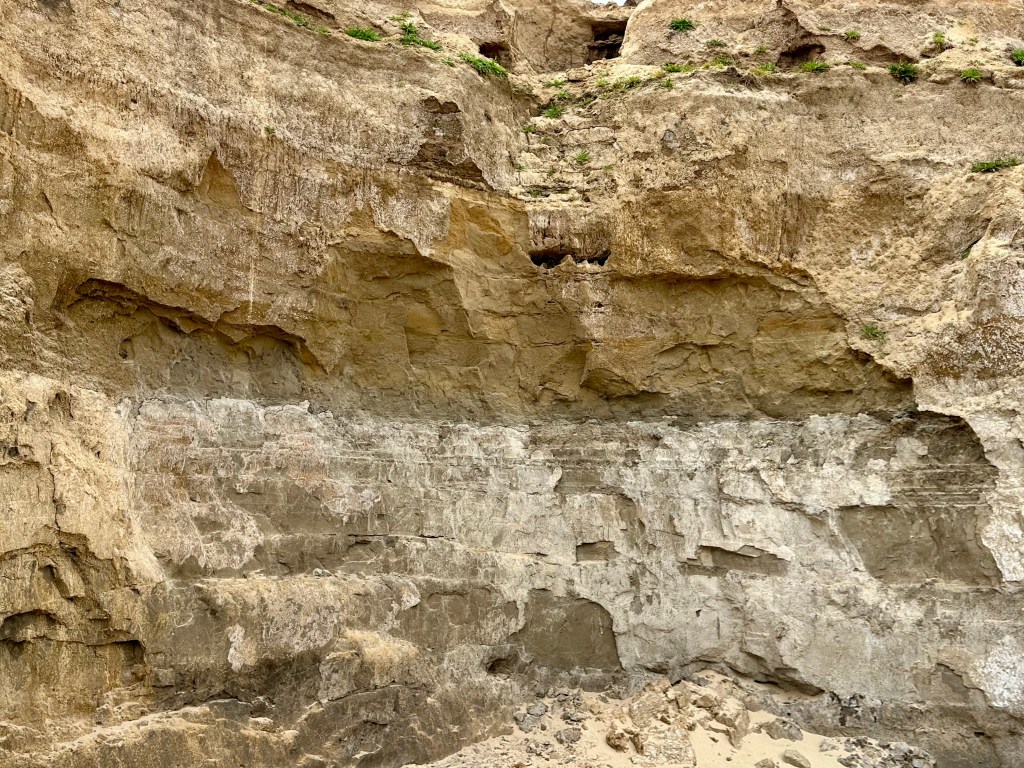
Wandering along the beach at Happisburg, I feel the immense pull of archeological history as I walk through a million years of Deep Time. The layers in the cliffs tell a story of what has gone before, but the sea is winning and every year the cliffs start to disintegrate. Happisburgh is slowly, but surely, disappearing, bit by bit, and one day it will just be a memory, like Doggerland before it.
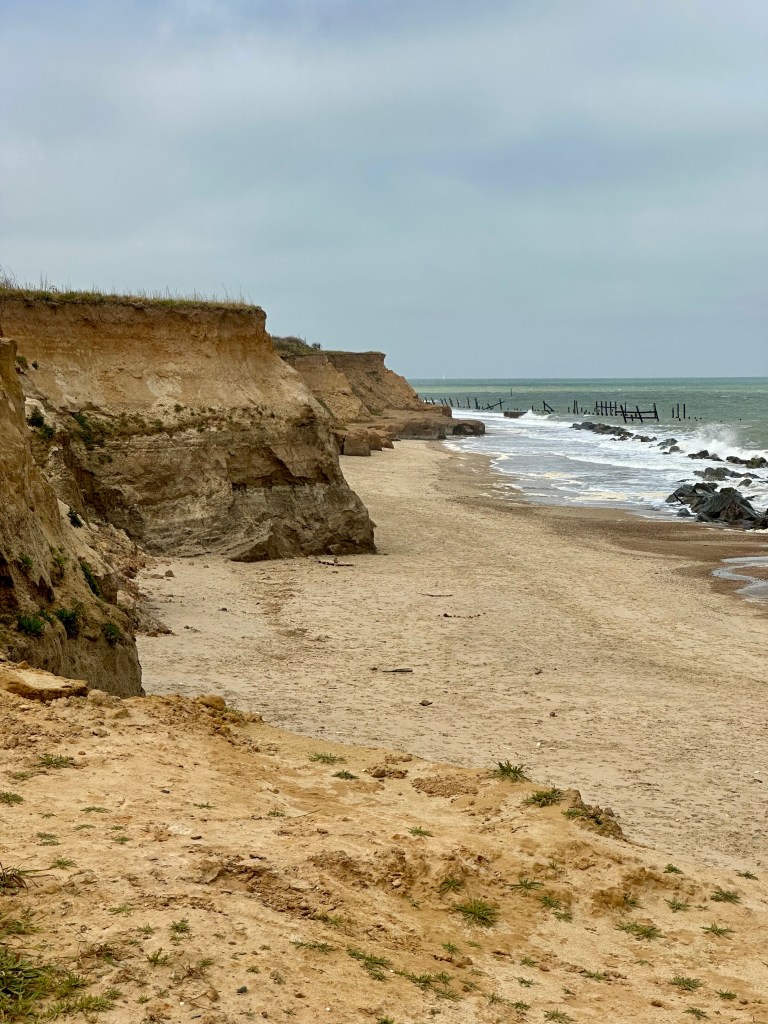

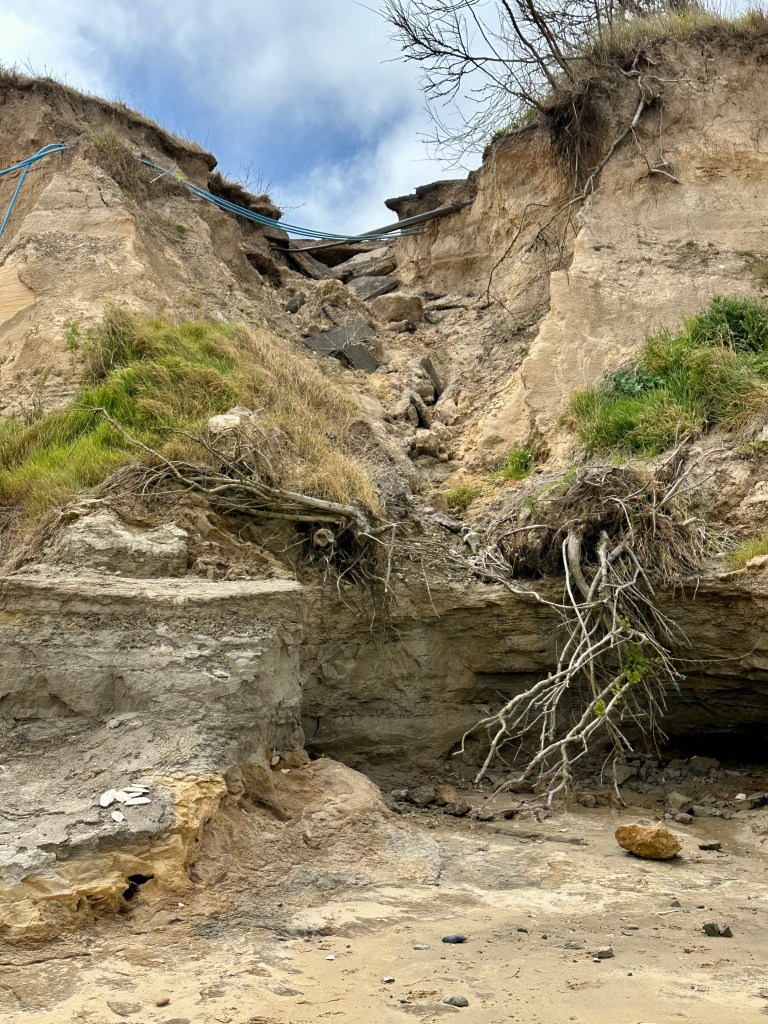
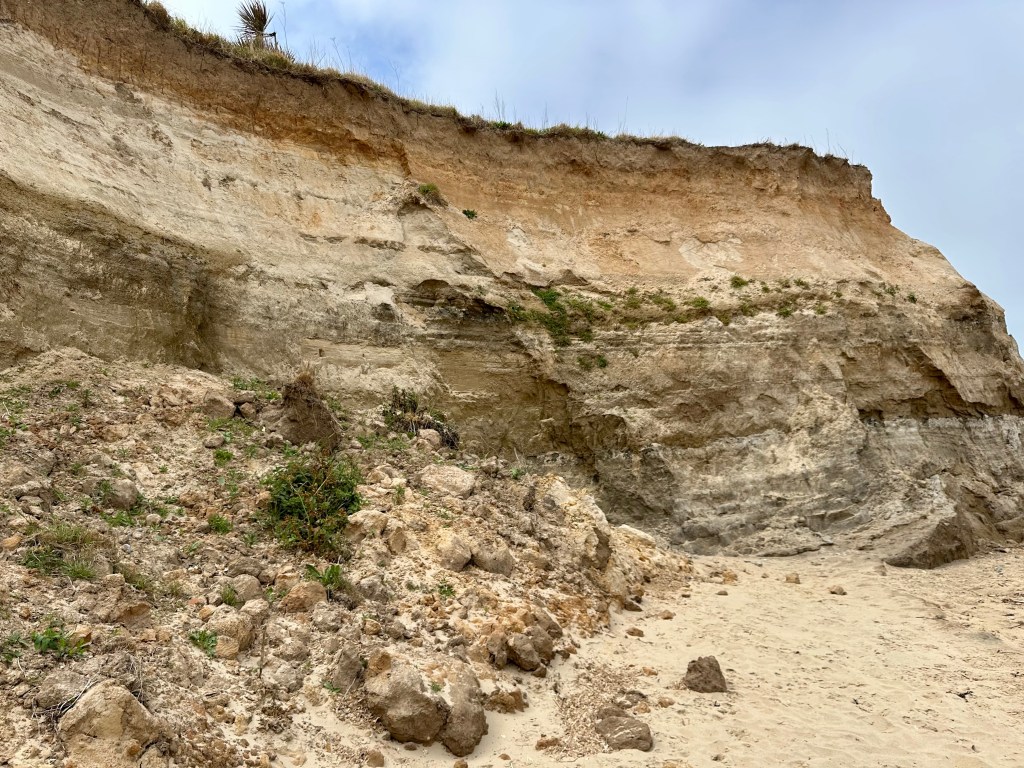
Doggerland is more than just a long lost physical landscape, its long history teaches us that change is constant and can end disastrously. These changes mirror what is happening in today’s world with Brexit, mass migration, the rise of populism and the weakening of the world’s democracies. Add man made climate change to the mix and it appears that we are on a slippery slope to destruction.
But within this mixture, there is still a glimmer of hope. However, we manage to deal with these threats, the story of Doggerland offers us perspective. The humans of Mesolithic Doggerland, as well as earlier visitors, were immensely resourceful and adaptable, moving to safer areas, as the waters slowly engulfed them.
In order to survive, we will need to be just as resourceful and adaptable as our ancient forebears. The coming years will be a roller coaster ride, but there is always hope that ‘Homo Sapiens’ has the ability and desire to prevent the cataclysm.
the rising waters
memories of Doggerland
submerged once more
 Life on the Edge
Very interesting and moving in equal measure. Wonderful photograph of the windmills, like a Monet
Yahoo Mail: Search, organise, conquer
LikeLiked by 1 person