"I had a moment of clarity, saw the feeling in the heart of things,
walked out to the garden crying."
Allan Ginsberg - From 'Transcription of Organ Music'
There comes a moment in all our lives, when there is a reckoning, a time of crisis and a need to confront our place in the world and how we move forward. We go through life blinkered, blindly groping our way forward in the darkness.
“For now we see through a glass darkly”2
Such a moment arrived in our lives recently, it involved an accident, a hospital, a chance trip to a magnificent ‘Neo-Gothic’ cathedral, and finally, a moment of clarity. This is how the story unfolded. It was a holiday long planned and eagerly awaited,
My sister-in-law, had travelled over from her home in Denmark, having long talked of a family holiday in Cornwall, together with us and our daughter, partner and grandson. The moment had finally come, and we arrived in our idyllic cottage in the beautiful Cornish hamlet of St Agnes. For the first few days, the holiday was everything we had hoped for, long walks, trips to the sea and pasties from the village bakery.
And then the bliss was shattered by what we -now call the’ bad thing’ or the ‘accident’. I will not dwell on this traumatic event, suffice to say that my wife had a bad fall outside the cottage and we knew immediately it was serious. The ambulance wait of 8 hours was a nightmare, the long delay exacerbated by the start of the holiday period, when everyone heads for the West Country. These first hours were among the worst of our lives and the trauma is seared in our minds forever.
The next few days rushed by in a blur, the x-rays, the diagnosis of a fractured femur, an operation for a brand new hip a couple of days after the fall and the gradual recovery, with a few setbacks, over the following days. The family was still in shock, wondering how the future would pan out, it was still early days and I admit, I was not thinking rationally.
A few of days after the operation, I decided to visit the capital city, Truro, only ten minutes from the hospital. It was not an auspicious start to my visit, it was market day in Truro, with hordes of people, and long queues for parking. I felt as though I was in an alien landscape.
I was at sea, unhappy and lost, a stranger in a strange land. I wandered round in a torpor, not taking anything in, a cup of coffee tasted poisonous and, in my fragile state, I decided that I would have to leave, as soon as I could, to maintain a hold on my sanity.
Then I came round a bend in one of the small, narrow streets and, there, unexpectedly was this marvellous building rising majestically in front of me. Of course, I knew Truro had a cathedral, but in my present state of stupor, I hadn’t even thought of it. It looked magnificent, but I was totally unprepared for the wonders inside.
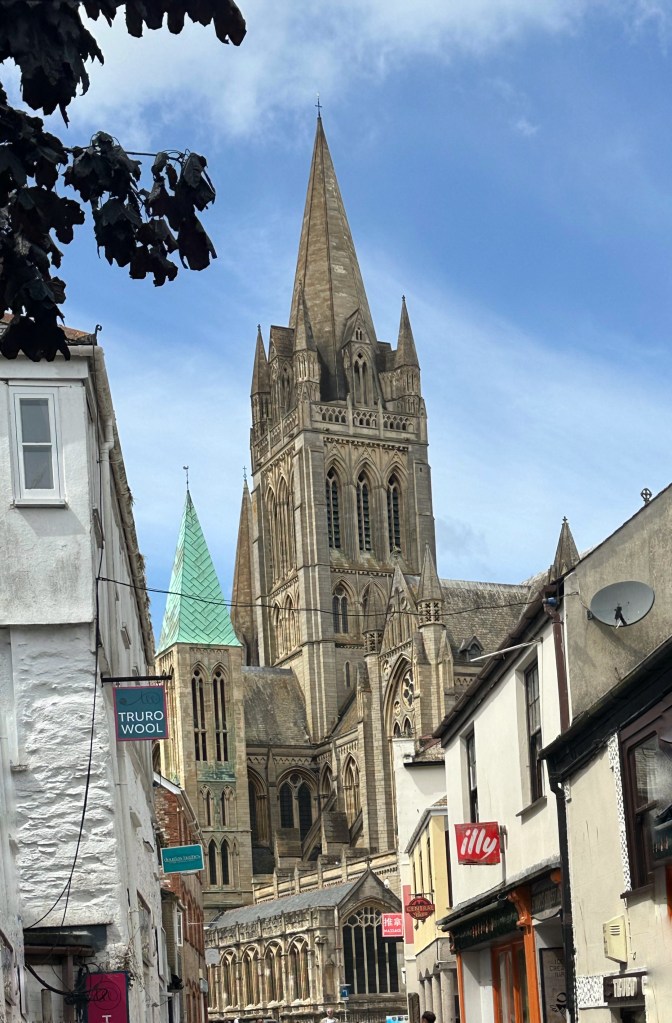
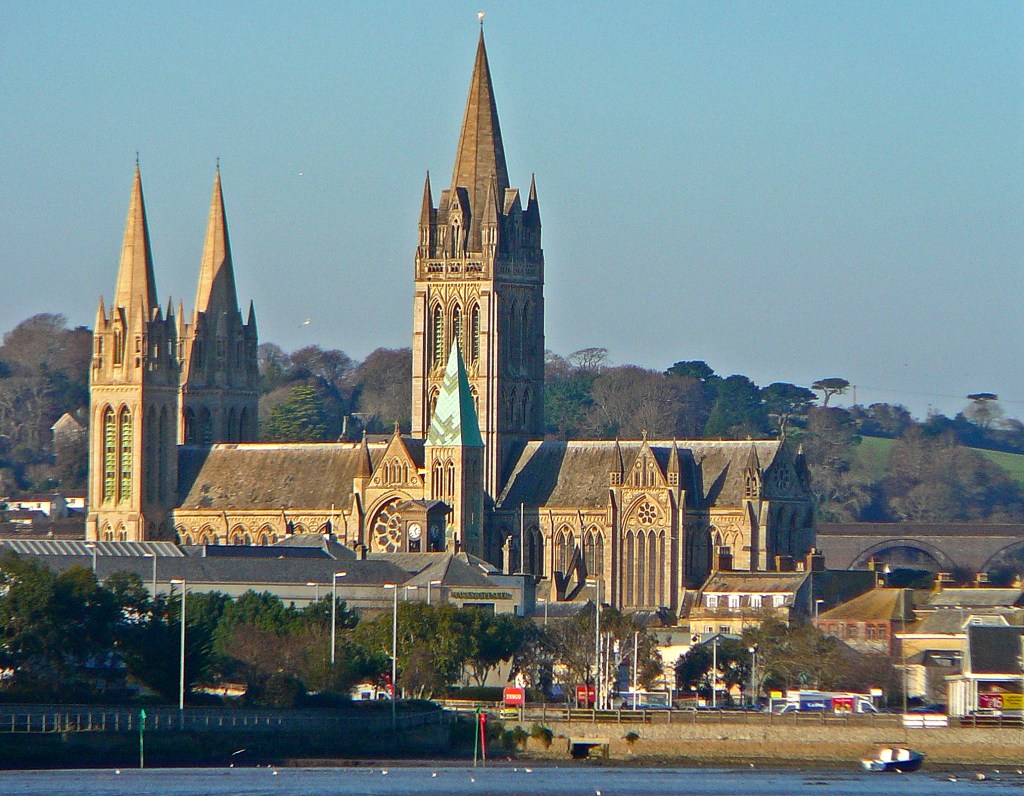
Before, I continue, I should say something of the history of this cathedral. Unlike, the majority of great cathedral cities, such as Salisbury, Winchester and Canterbury, this church is not a medieval masterpiece ,which has stood for centuries, but a relatively modern building.
In the 1870s, a historic decision was made to build a cathedral in Cornwall, on the site of the old St. Mary’s church in Truro:-
“The leading architect John Loughborough Pearson, who had experience of cathedrals elsewhere, was commissioned to design the new Cathedral of the Blessed Virgin Mary. Work began in 1880.
The project was ambitious. Truro would be the first Anglican cathedral to be built on a new site since Salisbury Cathedral in 1220. For over 650 years no one had attempted to emulate the great cathedral builders of the medieval era. As well as this, it was initially uncertain if there would be enough money to complete such a project.
The construction of the cathedral actually took thirty years……….Today, Truro Cathedral is seen as a triumph of Gothic Revival Architecture and its magnificent spires can be seen soaring above the city’s skyline, and, are at their best when silhouetted by the bright blue Cornish sky.“3
As I walked through the Cathedral doors, the sight that beheld me was not particularly promising, for this was a market day and, as a result, there was a craft fair with dozens of stalls filling up the centre of the church. I walked despondently around the stalls, looking at things which held no interest to me. I was on the verge of walking out, when something held me back, I should maybe stay awhile and see if there were any interesting internal features.
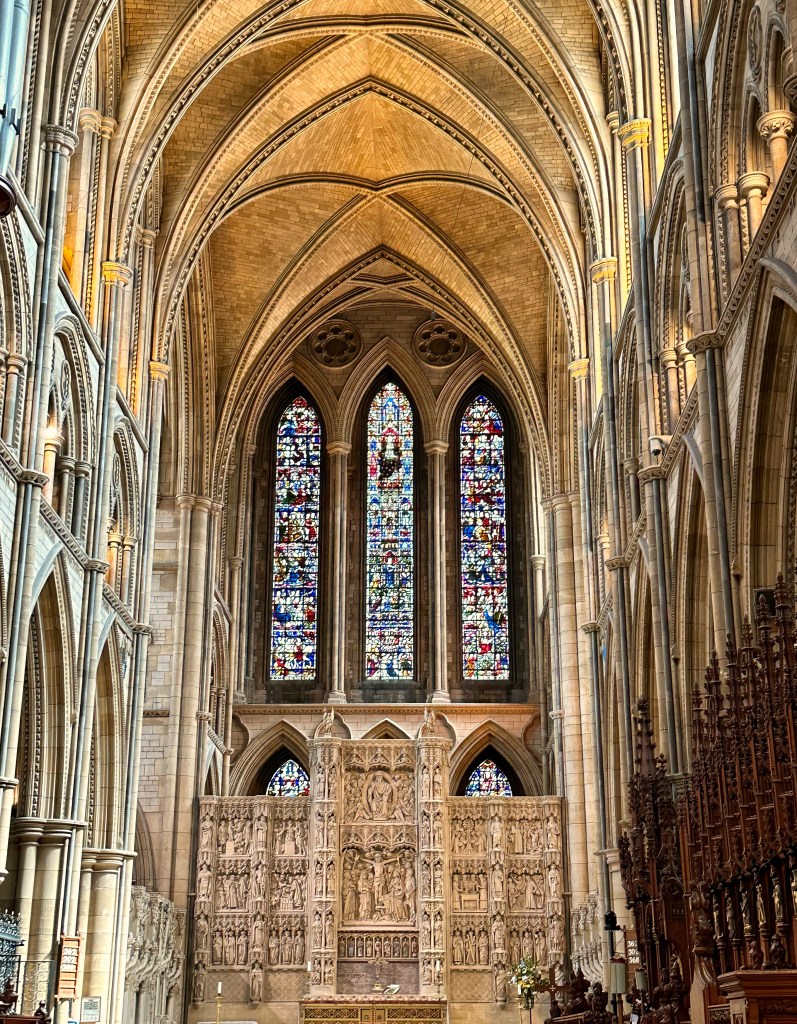
I then looked up at the ceiling and was spellbound, realising that this amazing vaulted ceiling was probably the first of its type to be built for hundreds of years, not since the glory days of the great medieval cathedral builders. And below the ceiling was a trio of magnificent stained glass windows.
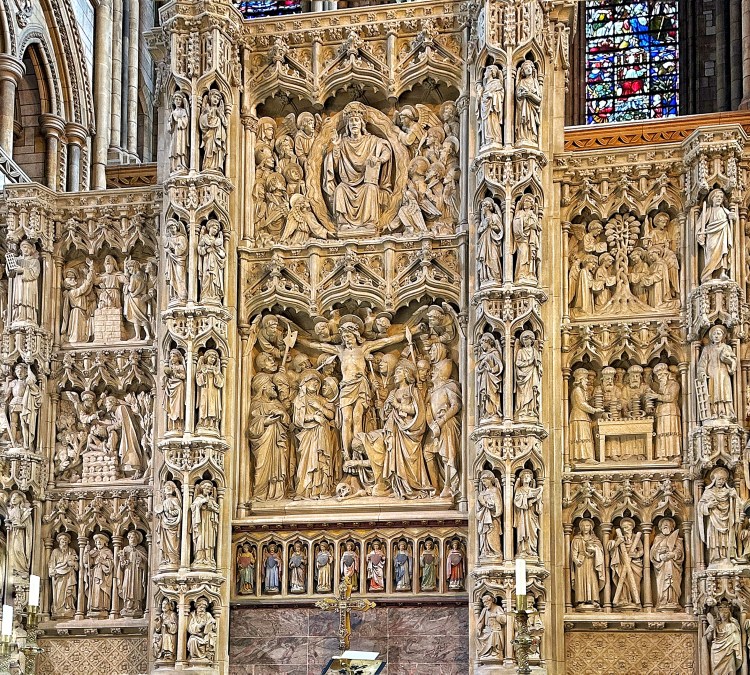
As my gaze moved downwards, my attention was caught by an enormous stone sculpture covering the back of the altar. This magnificent “Reredos”4, sculpted in bath stone, was covered in biblical characters worthy of any great Renaissance church and was made by the renowned Victorian sculptor Nathaniel Hitch, breathtaking in it’s complexity and beauty. However, there was more to come as I began to explore this fascinating cathedral.
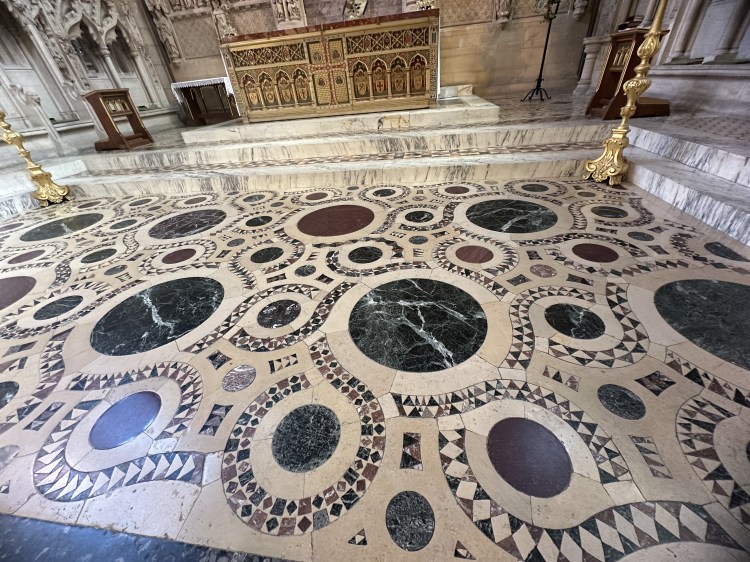
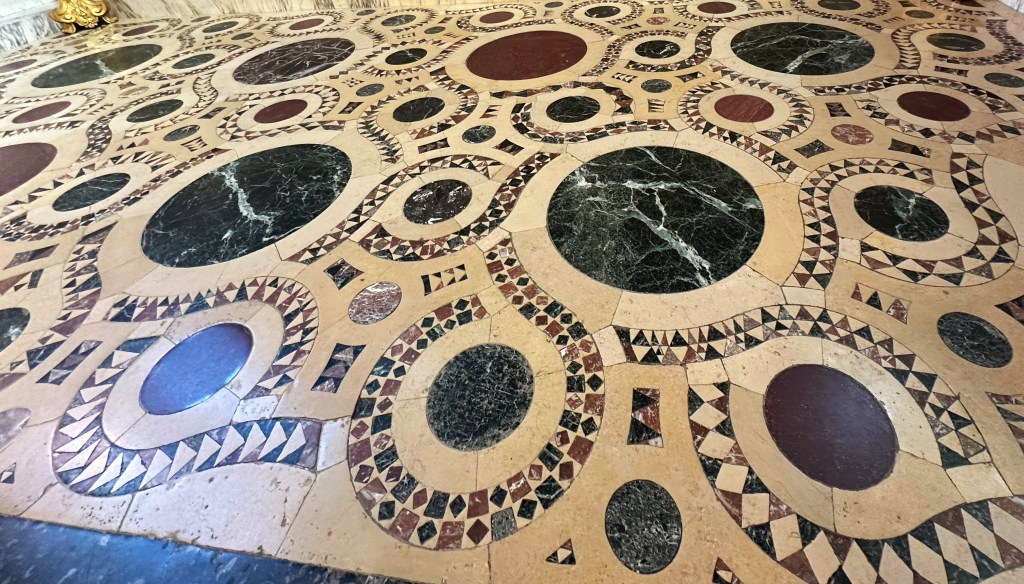
In front of the altar is a stunning marble floor in a wild curvy pattern, with different coloured mosaic inlays, and the overall impression I had was of a floor writhing in snakes. It would look more at home in a Moroccan mosque than a Victorian church in Cornwall, but no less beautiful for that
This beautiful Italian marble floor, was laid by an Italian craftsman, who was brought over especially by the church to lay the floor. During his stay in Truro, he met and married a Cornish lady, never to return home. There was probably not much work for a master marble craftsman in the area, so he changed career and ended up making ice cream, famous throughout the region for his traditional Italian ‘gelato’. A man of many talents.
But my journey of discovery was by no means over. Along a side wall was the most amazing Terra Cotta frieze entitled ‘The Way of the Cross’ and modelled in the most unbelievable detail. It was hand carved by George Tinworth, chief modeller of the Doulton Pottery factory in Lambeth and is a masterpiece of its kind. The detail shown in every figure is extraordinary and all range of expressions, from anger, compassion and sorrow can clearly be seen on the faces following Jesus holding the Cross on his way to Calvary. This can clearly be seen in the two images below:-
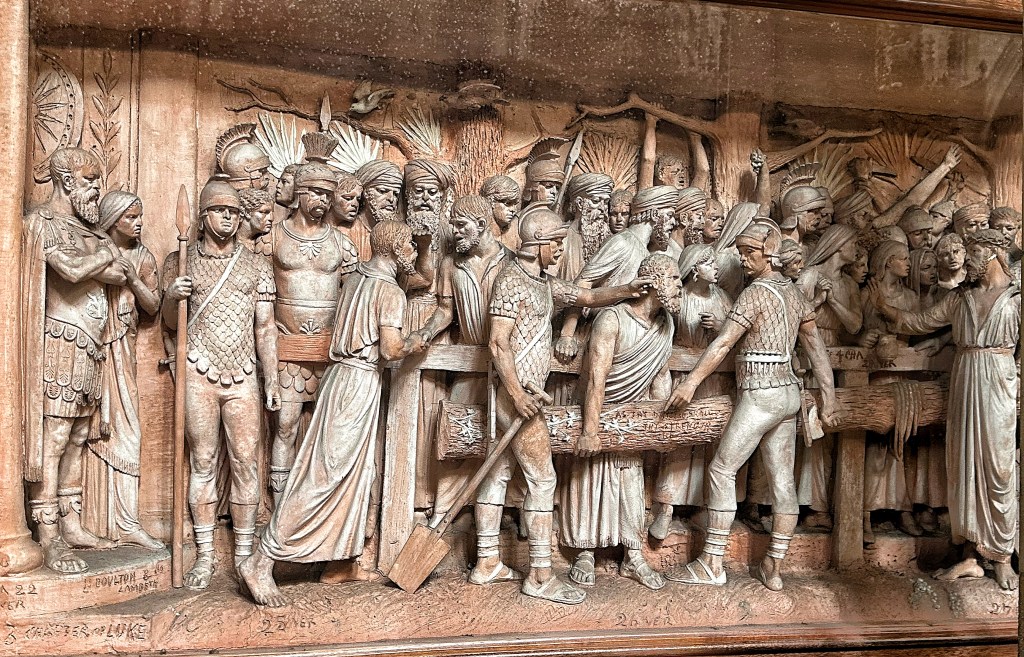
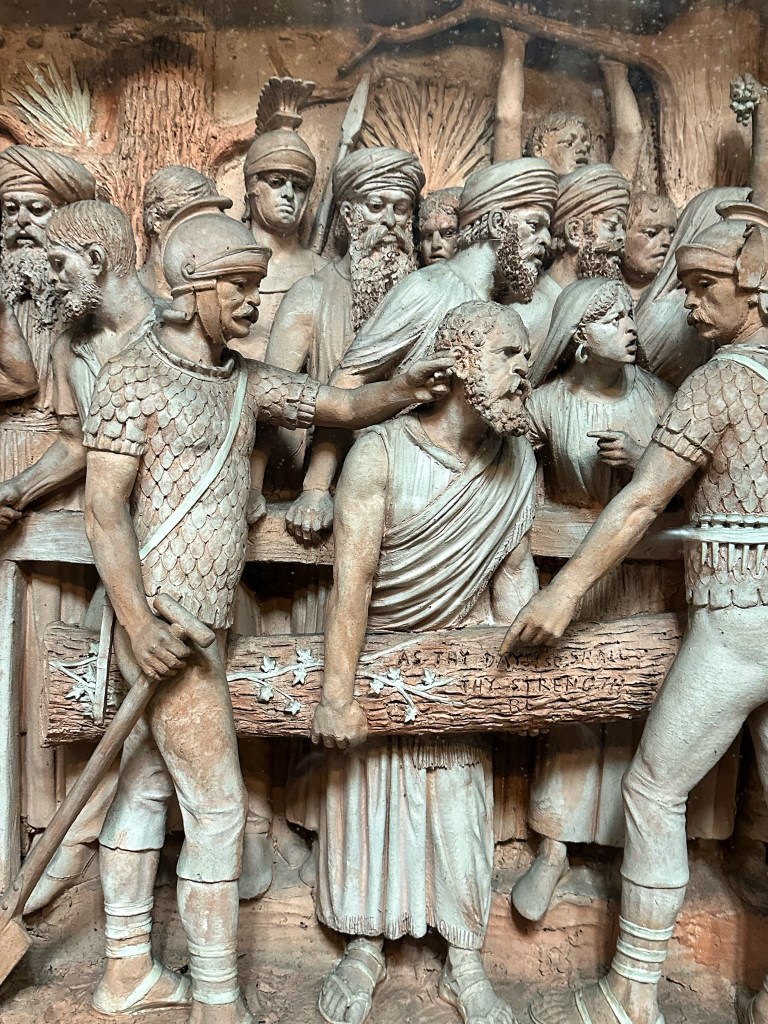
Finally, there are a number of 17th century monuments in the cathedral, moved from St. Mary’s church, which had been demolished to make way for the cathedral in 1880.
The one that drew me in, however, was the delightful Robartes monument, featuring John Robartes and his wife Phillipa Robartes. Mr. Robartes is lying on his side, looking very uncomfortable and holding his right side, with a pained look on his face. A fractured hip maybe?
She, on the other hand, is lying propped up by her elbow looking thoroughly fed up and bored, perhaps thinking, why am I lying here in such an uncomfortable position under this gloomy man for the rest of eternity.
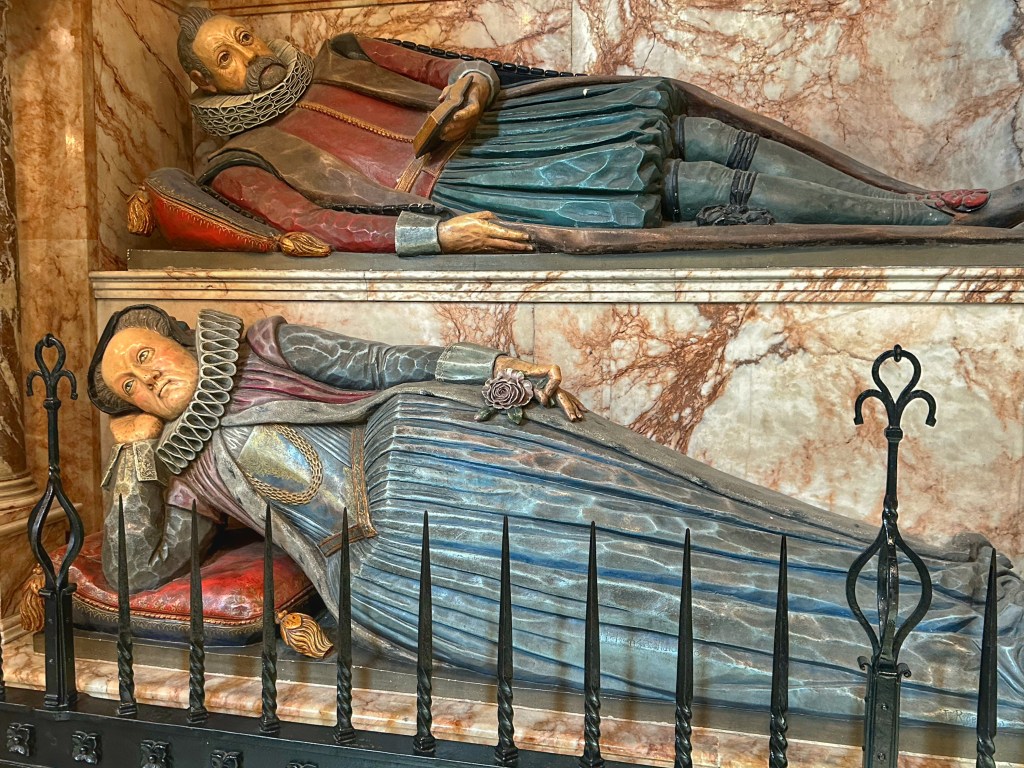
I had spent a fascinating hour, when I could forget the trauma of the past week and I came out of the cathedral feeling euphoric and strangely exalted. But then something else happened, for which I still have no explanation. I had a profound moment of total peace and acceptance, which descended on me.
Was I affected by the atmosphere of the cathedral? I’m not religious in the conventional sense, but I’ve often felt that places of worship hold a repository of memory and feeling, be they churches, mosques or ancient stone circles.
It was and still is a mystery. I know only that I had a moment of clarity or realisation, where I suddenly perceived, if only for a brief period, what was really important in life. Something had changed, the stress and anxiety were gone, if only for a short time.
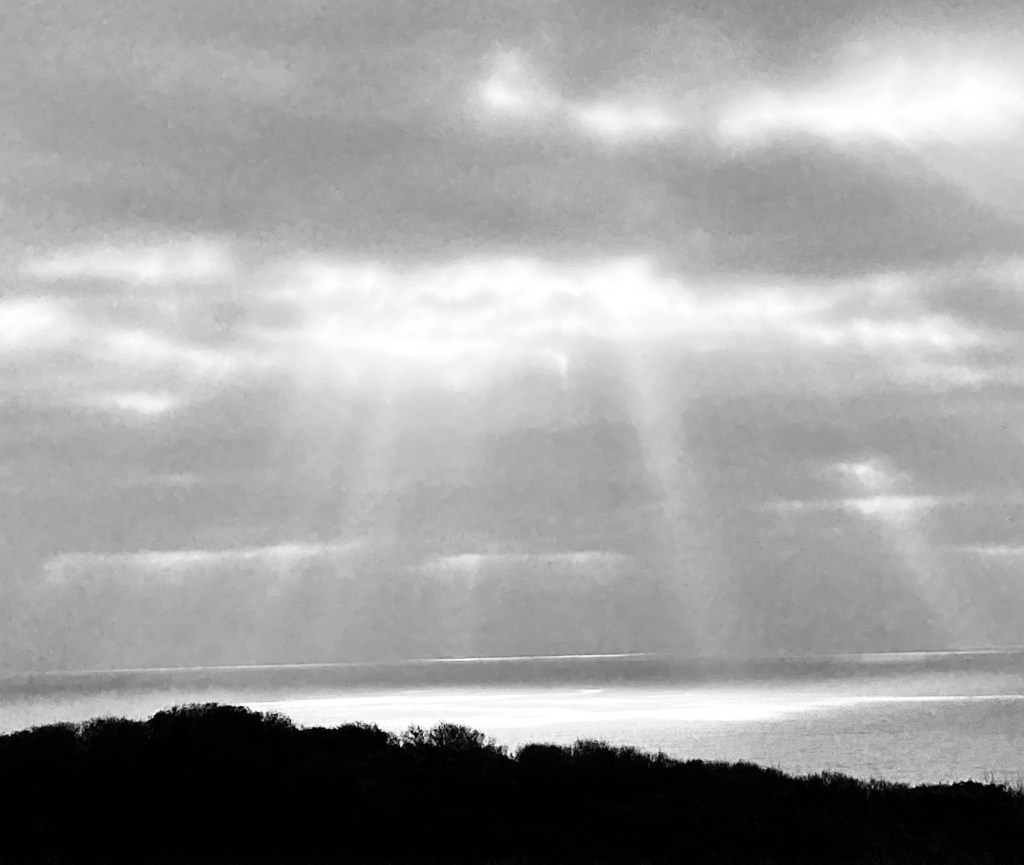
My wife is now home and recovering well, getting stronger every day, and looking forward again to the future. But this accident has been a wake up call for us, and we are reviewing our present lives, and discussing the path ahead.
Something has changed, but nothing has changed. Part of my Moment of Clarity, which I try to hang on to, is the knowledge that as we age, death is lurking and it will come for us all sooner or later. It may come tomorrow or in 20 years time, so we should seize each day anew and live our best lives, while we can. With that thought in mind, we aim to move forward with acceptance and hope.
“All shall be well, and all shall be well, and all manner of things shall be well”5
Notes
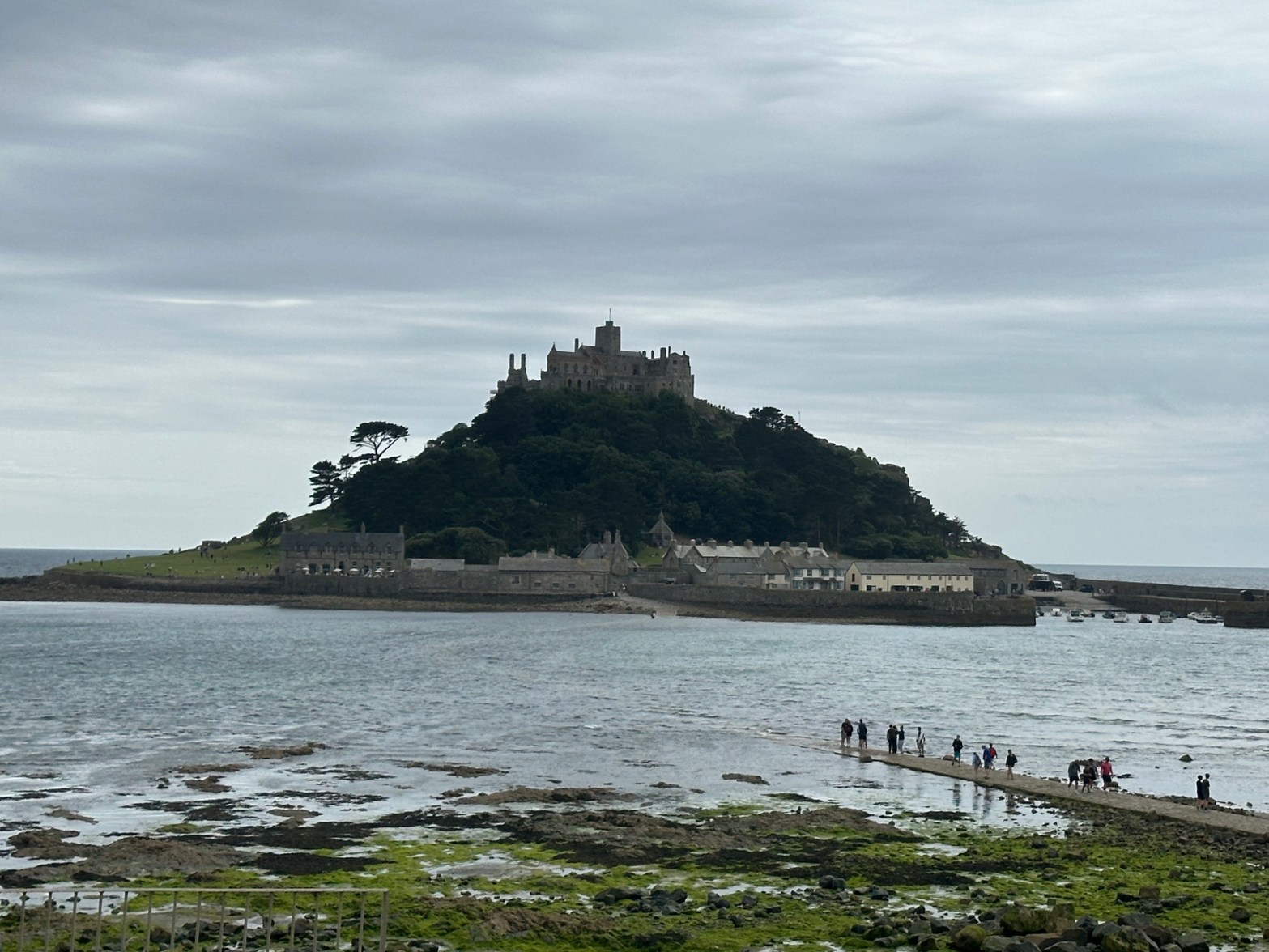
1. Cover photo – St. Michael’s Mount of Marazion, Cornwall, an ancient place of great atmosphere and beauty.
2. To see “through a glass darkly” is to have an obscure or imperfect vision of reality. A Biblical phrase from 1 Corinthians 13:1.
3. Extract from the official Truro Cathedral website, see link ‘Truro Cathedral – History’
4. ‘Reredos’ – an ornamental screen covering the wall at the back of an altar in a church.
5. This is a quote from Julian (or Juliana) a 14th century mystic and anchoress, who had survived the Black Plague. She never discounted the terrible suffering that humanity goes through every day and that she also went through, but her vision of radical optimism rose above that and bears similarities to Buddhist thought and philosophy.
6. All photographs by John Bostock, with the exception of the view of the cathedral across the river, which is in the public domain.
 Life on the Edge
Thank you, John. Reading this on a rainy Saturday morning feels like a little blessing. Perhaps something of your moment of the heart has carried its scent into your writing..
I love the picture of the mosaic. It reminded me of the beautiful mosaic work in Westminster Abbey, where they had sent for Italian craftsmen to do their ‘Cosmati Work”
https://www.patricialovett.com/cosmati-pavements/
LikeLike
Thank you so much Francesca, that comment means a lot to me. At the moment, I feel a bit like the narrator of the ‘Ancient Mariner’ compelled to tell my story. I hope mine has a happier outcome than his story. And thanks for the links to Italian mosaic work in Westminster Abbey. I did not know about ‘Cosmati work’, its great to learn new things.
LikeLike
My ‘moment of clarity’ came with the chance sight of an Icon in a closed church’s porch. When I needed to be the steady and calm one and knew I did not have the resources. I don’t understand or ‘know’ anything, neither am I good (if you are good and know stuff why ask for help?). Anyway – it works for me – hope is undervalued. Calm and hope to you both.
LikeLike
Hi Val, Lovely to hear your story. I believe these ‘lightbulb’ moments arrive at times of stress, from a place deep within, and give us strength and hope to carry on.
LikeLike