Lewis Valentine – Welsh Patriot and Pacifist
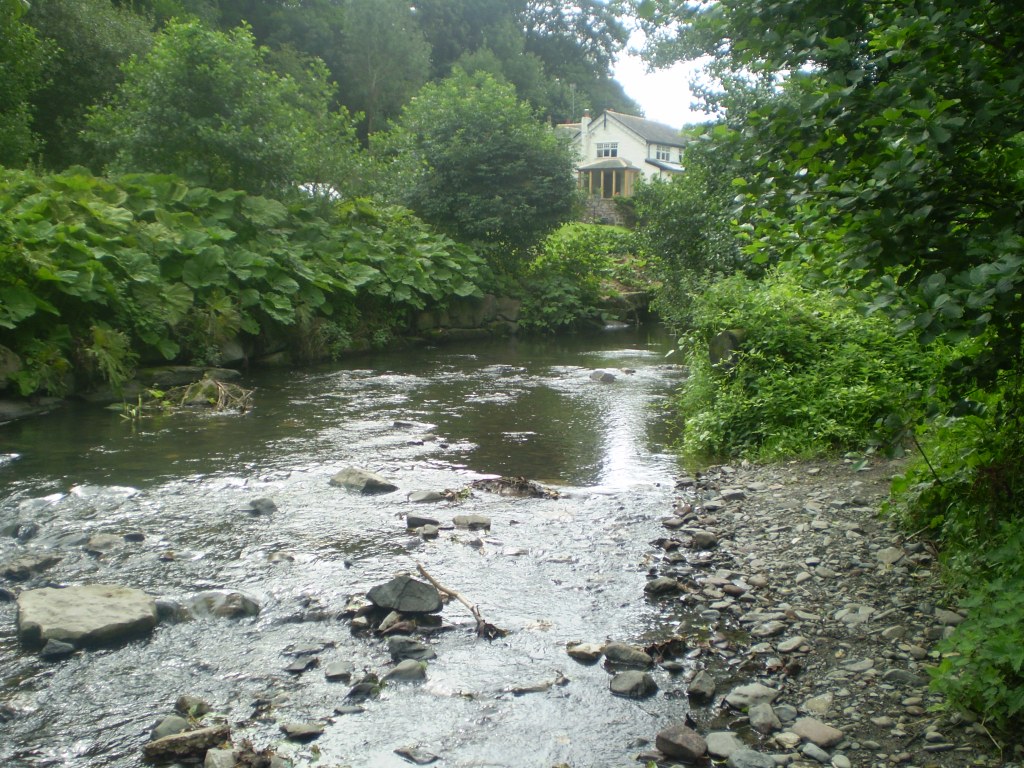
Llanddulas is a small village along the North Wales coast of about 1,500 people, midway between Abergele and Colwyn Bay. It derives its name from the River Dulas, which winds its way through the village, bound for the Irish Sea. In past times you would have driven through the village and perhaps tarried a while, on your way to one of the tourist destinations such as Llandudno, Conwy or Angelsey. These days the North Wales Expressway, the A55, bypasses and ignores Llanddulas, cutting off the village from the beach, which is also hidden by a seemingly unending row of caravan parks. However, if you travel about a mile inland to the neighbouring tranquil and beautiful hamlet of Rhyd-y-Foel, you get a glimpse of what Llanddulas was like before modern life came along with its wrecking ball.
One of the most momentous events in British history occurred in Llanddulas just over 600 years ago, but appears to be almost unknown locally. In 1399, Richard II was ambushed by Henry Bolingbroke on his way back from Ireland, at Penmaen head, a rocky outcrop just outside Llanddulas. He was forced to surrender and was deposed as king, thus ending 300 years of the Plantagenet dynasty and sowing the seeds for the Wars of the Roses between the Houses of Yorkshire and Lancashire in the mid 15th century. Strangely enough, there is no commemoration anywhere in the area to mark this turning point in British history.
However more recently, it is celebrated as the birthplace of the Welsh patriot, Lewis Valentine, who infamously was involved in the arson attack on a controversial bombing school in Penyberth in 1936 and later became one of the founding members of ‘Plaid Cymru’, the Welsh Nationalist Party.
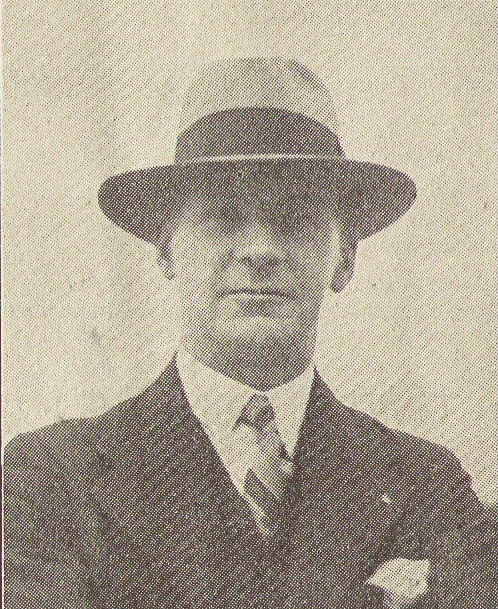
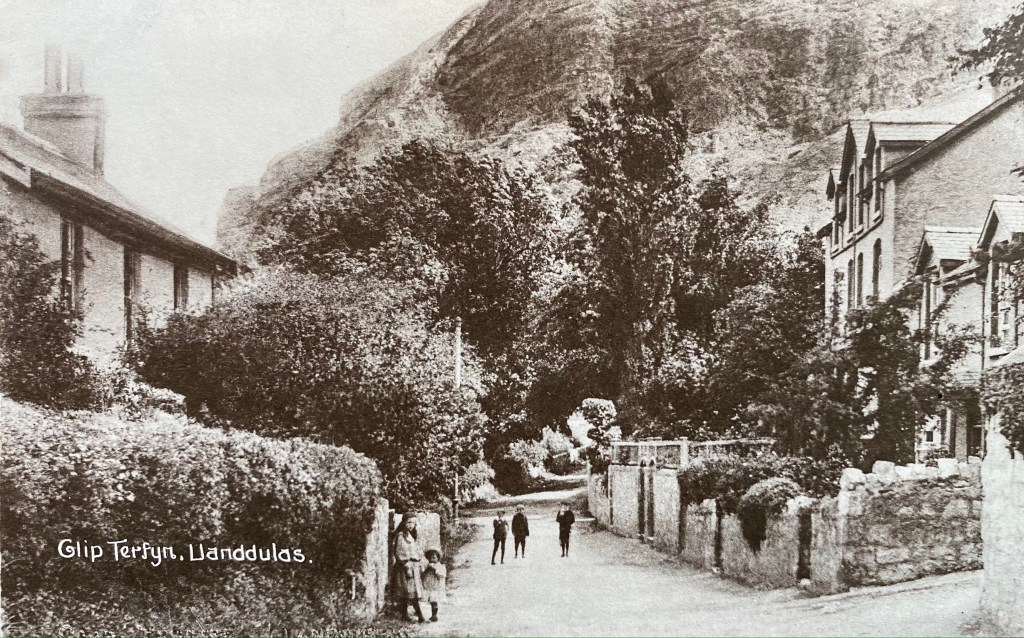
He also happens to be a relative of mine, albeit a distant one and this is his story, which is closely intertwined with my own family history, due to the fact that he was born in the house where my family later lived, a house named ‘Hillside’, situated on the small lane of ‘Clip Terfyn’ on the eastern outskirts of the village.
Llanddulas and ‘Hillside’ hold a special place in my heart and I spent many happy holidays there as a young child, while my ‘Nain’ (Grandma) and ‘Taid’ (Grandpa) were alive, roaming free on the large limestone hill (Cefn-yr-Ogof) overlooking Clip Terfyn.
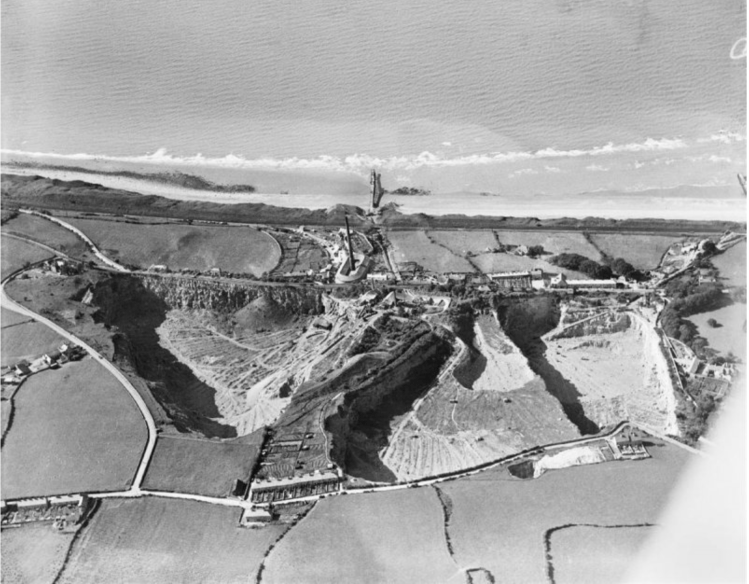
Limestone is the key to this part of North Wales, it was the lifeblood of the village and provided employment for its men for 200 years. Limestone was first quarried in Llanddulas in 1696, but during the 19th and 20th centuries, became a major industry with the limestone being transported by a specially constructed railway line from the quarries to a jetty on the beach, where it was shipped off to many places around the world. The extent of the devastation to the area can be seen below, in this aerial photograph from the 1930s, which shows three enormous craters on the outskirts of the village and the jetty can also be clearly seen. In 2021, the glory days of limestone quarrying are now in the past and many of the quarries have been filled in and returned to nature.
However, in the past, everyone in the area seemed to have had some sort of connection to the limestone quarries, both my great-grandfather and great-great-grandfather were quarrymen, although my grandfather managed to escape the quarry by starting his own own taxi and haulage business.
Life for the limestone quarrymen was hard and relentless, with long hours in appalling conditions and many people died before their time. My Great Grandfather, Thomas Roberts, dropped dead at the age of 38, leaving my Taid having to find work as a farm labourer at the age of 14, in order to bring money in for the family.

The other main driving force in the area was religion, which came in two forms of Protestantism, Methodist and Baptist, which although different in many ways, were both of a fundamentalist nature and emphasised the rewards of hard work and a strict obedience to the Gospels. This meant that for most people in the village, there was church several times on a Sunday and the majority of the population were strict teetotallers.
My Mother’s side of the family were Methodist and had worshipped in Welsh at the Salem Wesleyan Chapel in Rhyd-y-Foel for several generations, whilst the Valentines were strict Baptists and attended the Bethesda chapel in the heart of Llanddulas.
Lewis Valentine was born in ‘Hillside’ in Clip Terfyn in 1893 to Samuel Valentine, a lay preacher at the Bethesda Chapel and a checkweighman at one of the limestone quarries, and Mary Roberts, who was the sister of my Great Grandfather, Thomas Roberts, hence the family connection.This meant my ‘Taid’ was first cousin to Lewis Valentine.
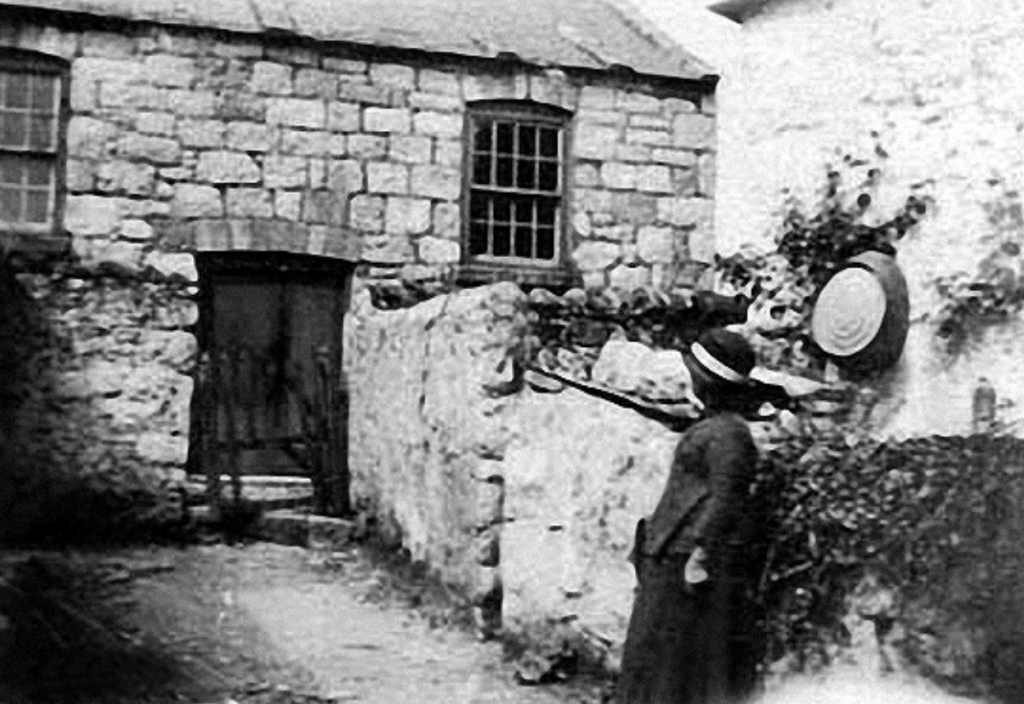
My grandparents lived a few doors down in Clip Terfyn from the Valentines in a small cottage called ‘Mountain View’ and my mother clearly remembers regular Sunday tea visits at ‘Hillside’ with Uncle Samuel and his family, but by that time, Lewis was married and was an ordained Baptist Minister in Llandudno. In about 1933, ‘Taid’ purchased ‘Hillside’ from Samuel , who was moving away from the district, which was how my Mother grew up in the house that Lewis had once spent his childhood.
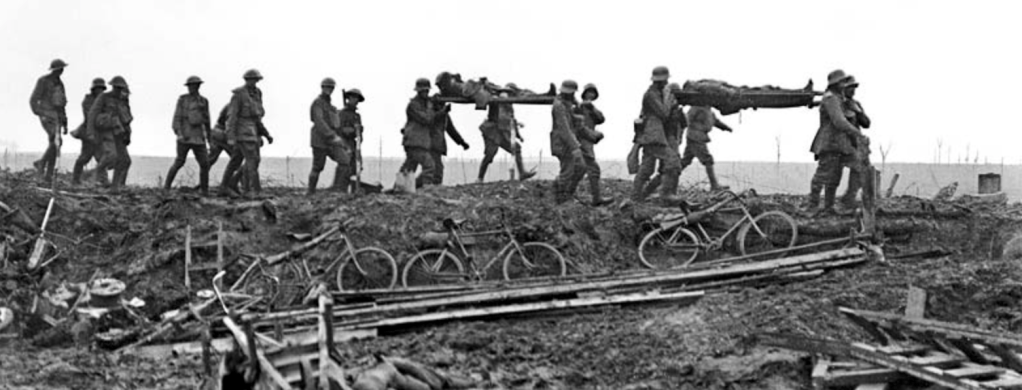
The Bethesda Chapel was of enormous influence on Lewis as he was growing up and although he studied Welsh and Semitic languages at University, it was his intention to become a Baptist Minister once he had graduated. However, the First World War got in the way and although he already had strong pacifist leanings, he volunteered in the Royal army Medical Corps as a stretcher bearer.
His role as a stretcher bearer meant he witnessed some terrible sights in the worst battles of the war, including the Somme, Arras and Ypres, culminating in the living hell of Passchendaele, where in 1917 he was subjected to a gas attack, which left him blind and unable to speak for several months. These experiences, plus the loss of his closest friend Frank Carless, left an indelible mark on the young Lewis Valentine and left him with a visceral hatred of war, which stayed with him for the rest of his life..
The war convinced Lewis that his calling was as a Minister of the Church and in 1921 he was ordained as a Minister in the Welsh speaking Tabernacle Baptist Chapel in Llandudno, the largest Baptist chapel in North Wales. Over the next few years he established a reputation as one of the great preachers of his generation and his fame spread throughout Wales.
It is hard to imagine in this day and age, when religion plays such a small part in people’s lives, how much these preachers were hero worshipped and were almost the rock stars of their day. There is a unique Welsh word for this called ‘Hwyl’, which was a special characteristic of traditional Welsh revivalist preaching, which led to a surge of intense emotional and spiritual fervor between the preacher and the congregation. The ‘Hwyl’ is sometimes induced by chanting the attributes of God in a rhythmic sequence.
The upsurge in religious fervour, especially in North Wales, can be traced back to what is known as the Welsh Revival of 1904 -1905, when Joseph Jenkins, Evan Roberts and other charismatic preachers toured Wales converting thousands of people. This mass movement had an enormous impact on people’s lives and continued well into the middle of the 20th century.

During this period Lewis had married Margaret Jones in Llandudno and started a family. Meanwhile, his growing brand of Welsh Nationalism, a heady mix of religion, language and nationhood, was being fuelled by his passionate love of the Welsh language, which he felt was in danger of being subsumed by English.
Language gives a nation its unique identity and the Welsh language is no exception. For centuries, beginning with Henry VIII, the English had tried to suppress and destroy the Welsh language, by banning Welsh in schools and in workplaces, often through corporal punishment with the barbaric use of flogging, named the Welsh Not or Knot
This and other systematic tools of oppression was bound to lead to a renewed independence movement and by the early part of the 20th century, many Welsh patriots were looking to form a new political party. In 1924, Lewis met other like minded colleagues in Caernarfon, who launched Plaid Genedlaethol Cymru (The National Party of Wales) in 1925 and Lewis Valentine was elected as the first president, a post which he held for a year until he was succeeded by Saunders Lewis, one of the other founders. It is not so well known, that he was also the party’s first parliamentary candidate in Caernarfonshire in the 1929 general election, where he polled 609 votes. It was not until after the 2nd World War , that Plaid managed to elect its first MP, Gwynfor Evans.
And then we come to the action that has gone down in legend as ‘Tân yn Llŷn’ (Fire in Llŷn) which ignited the Welsh Nationalist cause and earned Lewis Valentine both notoriety and eminence in equal parts, depending on your viewpoint. In the 1930s, the Ministry of Defence had announced their intention to build an RAF Training school on the Llŷn peninsula at Penyberth, after two English sites had been rejected due to protests from Naturalists and Historians. However, despite widespread objections from all walks of life including many distinguished Welsh academics, Stanley Baldwin, the Prime Minister at the time, pushed through the decision without any local consultation.
To the leadership of the newly formed Plaid Cymru, it felt like an act of pure vindictiveness and the decision was made to strike a blow for Wales and the Welsh language, by a symbolic act of arson. For Lewis Valentine, it was also a means of protesting his hatred of war, which came out of his experiences in the first world war and to gain publicity for the Nationalist cause.
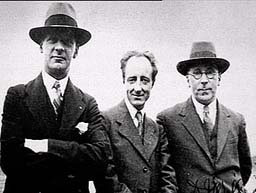
The three men who carried out this attack, all pillars of society in their respective professions, Lewis Valentine, a Baptist Minister, Saunders Lewis, a University Lecturer and D.J. Williams, a schoolteacher, were the unlikeliest of saboteurs, but on the 8th September 1936, they calmly drove to Penyberth and set fire to sheds and offices on the site, which were in the process of being constructed. They then drove to the nearest police station and handed themselves in, their work accomplished.
The three men can be seen the photograph below, taken in 1936. Lewis Valentine is on the left towering over his two compatriots, Saunders Lewis and D. J.Williams.
At the trial in Caernarfon, a Welsh jury could not come to a verdict, so there was a controversial decision to hold a retrial at the Old Bailey in London, which angered many people in Wales. At the retrial, Lewis enraged the Judge by refusing to engage with the court in English and he gave an impassioned speech on behalf of his beliefs from the dock in Welsh.
Needless to say, all the men were convicted and were sentenced to 9 months imprisonment in 1937 in Wormwood Scrubs. They returned home to Wales as heroes and were met by a cheering crowd of 12,000 people in Caernarfon. My mother, who was 13 at the time, remembers how proud the people of Llanddulas were, including my own Taid, of their most famous son. His job as a Minister had been kept open and he recommenced his life in Llandudno, preaching to large congregations.
From this time onwards, Lewis settled back into the life of a Baptist Minister and withdrew from the centre stage of Welsh politics, but this one defining act had ensured his place in the mythology of Plaid Cymru. He also became a respected poet and writer, magazine editor and literary critic.
Throughout his life, he continued to push the case for the Welsh language, which he saw as being in crisis and in 1962 he gave an address, where he stated that ‘the great call for the Welsh-speaking Christians of Wales today is to save the Welsh language as a medium to promote the Kingdom, and as a medium to preach the Word’
At this time, he also wrote the words of a patriotic hymn, which he decided to set to the tune of ‘Finlandia’. Lewis was a serious admirer of both Sibelius and Finland and felt their situation in respect of independence, in many ways, mirrored that of Wales. Choosing to set his words to one of the most achingly beautiful tunes ever written was an act of genius and ensured that this hymn became so well known, that today that it is now regarded by many people as Wales second National Anthem. This is the full text below in the original Welsh and in translation:-
Dros Gymru’n gwlad, O Dad, dyrchafwn gri,
y winllan wen a roed i’n gofal ni;
d’amddiffyn cryf a’i cadwo’n ffyddlon byth,
a boed i’r gir a’r glan gael ynddi nyth;
er mwyn dy Fab a’i prynodd iddo’i hun,
O crea hi yn Gymru ar dy lun.
O deued dydd pan fo awelon Duw
yn chwythu eto dros ein herwau gwyw,
a’r crindir cras dan ras cawodydd nef
yn erddi Crist, yn ffrwythlon iddo ef,
a’n heniaith fwyn a gorfoleddus hoen
yn seinio fry haeddiannau’r adfwyn Oen.
Translation:
For Wales our land O father hear our prayer,
This blessed vineyard granted to our care;
May you protect her always faithfully,
And prosper here all truth and purity;
For your Son’s sake who bought us with his blood,
O make our Wales in your own image Lord.
O come the day when o’er our barren land
Reviving winds blow sent from God’s own hand,
As grace pours down on parched and arid sand
We will bear fruit for Christ by his command,
Come with one voice and gentle vigour sing
The virtues of our gentle Lamb and King.
There are many versions of this hymn, some excellent, and some frankly dire. I have chosen below my two favourite versions. In the first version, it starts out with the single tenor voice of John Eifion with piano, moving onto a small group of singers and finally to full blown choir with a stirring organ accompaniment.
The second version, by Dafydd Iwan, a well known folk artist in Wales and himself a former President of Plaid Cymru, is more restrained, but has a simplicity that I found very appealing. You can make up your own minds, which version you prefer.
Lewis Valentine had left Llandudno in 1947, to be the Minister of a chapel in Rhos, a mining village and he stayed there until his retirement in 1970 when he and his wife moved back to Llanddulas. They felt, however, that the village had changed for the worse and they soon moved again to nearby Old Colwyn, where Lewis spent the rest of his life, dying in 1986 at the age of 92.
In 1996, a memorial to Lewis Valentine in the shape of a pulpit in local stone and slate was built in Llanddulas. On top it states ‘Righteousness exalts a Nation’ and ‘Blessed are the Peacemakers’ and below it reads ‘To the Glory of God, in memory of the Reverend Lewis Edward Valentine MA DD, 1893 -1986, Minister of the Gospel, Nationalist, Pacifist’
A fitting tribute and in a supreme irony it sits on land directly opposite the local pub, aptly named the Valentine Arms. What Lewis, a life long teetotaller, would have made of this can only be guessed at, but I would hope that he would have been wryly amused.

What of his legacy? I’m sure he would have been delighted that Wales has more autonomy and its own Parliament and of course it would have been a great source of comfort to him to know that the Welsh language has enjoyed such a great renaissance and its survival now seems assured well into the future. His views on modern life, however, might have been more mixed, in particular the godlessness that he would have perceived around us. He would, no doubt, still have wished for full independence for Wales, especially in today’s uncertain climate, following the political and social upheavals of recent years.
And how do I feel about my first cousin twice removed? He was a man of his time and his world is not my world and his religion is not my religion. Looking at his life though, even through the lens of today, it can be seen that he was a man of principle and conviction who believed in the fellowship of man and the desire for world peace. In contrast to most of the self serving public servants and politicians in office today, he comes across as a towering figure of integrity and the conclusion has to be that his was a good life, well lived.
In researching this article, it made me think deeply about what it means to belong and about my own cultural heritage. In one of my recent articles I wrote about my father’s family that could be traced back centuries to Nottinghamshire, now I am writing about by Welsh heritage and in truth, like everyone, I am a mongrel. If anything, I am a European and to use that much maligned expression, a Citizen of the World. However, I realise there is a part of me that will be forever Welsh and whenever I go back to the hills and valleys of Wales, my heart sings that I am in ‘Hen Wlad Fy Nhadau’.
Ar gyfer fy mam, Gwyneth Mary Roberts
 Life on the Edge
Very interesting to learn more about Mr Valentine. He was quite a man really wasn’t he? As a young child I might well have seen him around Llan I guess but as a teenager I would have greatly dissapointed him due to having my Hwyl removed by the influx of Sais that was foisted upon us, allmost unnoticed 😐 I really wish I’d been forced/inspired/cajoled in speaking Welsh to the point of fluency at the time 😦 Finally for now wouldn’t it be great to have someone (or many more) like him around nowadays. Have you seen what they’ve done to St Cynbryd’s Church 😦
LikeLiked by 1 person
Thank you Ada, I’m glad you liked the article. We haven’t been to Llanddulas much in recent years, but I brought my Mum up about 4 years ago and we stayed in Ryd y Foel and I felt that Llanddulas wasn’t the same as it used to be, although Clip Terfyn still seemed to be fairly unspoilt. I’m afraid I don’t know St Cynbryd’s church, but I saw your Facebook post about it, looks a beautiful church. Why can’t people leave things as they are?
LikeLike
Where is he Berried…..?
LikeLike
That’s a good question, Peter. He lived in Old Colwyn in his last years, so I assume he is buried there. It needs more research.
LikeLike
Interested to read your account.
I was privileged to talk with Lewis Valentine when he was in the Nursing Home towards the end of his life, as I was researching the African Training Institute in Colwyn Bay. He shared his memories of going to school with the African students there, and spoke well of the Founder Rev William Hughes, another controversial figure. I can share my notes on the meeting if you are interested.
LikeLike
How interesting. Unfortunately, I never met my relation, so would be fascinated to read your notes. Thank you, Hazel.
LikeLike
Dear John, Good, glad you are interested. I will get my notes out, then look for a spare hour to write it out … Hazel
Sent from Mailhttps://go.microsoft.com/fwlink/?LinkId=550986 for Windows
LikeLike
Many Thanks Hazel, only if it’s not too much trouble
LikeLike
Not at all, Id be glad to share the experience with someone whod be interested.
Sent from Mailhttps://go.microsoft.com/fwlink/?LinkId=550986 for Windows
LikeLike
Dear John, At last I have found that spare hour to reply! I met Rev Lewis Valentine (& I’m relying on my notes here) on 5th July in 1984 in Como Nursing Home. He was 91 (I note he died in ’86). I was in my thirties doing a Masters at the School of Oriental & African Studies in London, and was looking in to the African Training Institute (earlier known as Congo House) that had existed in Colwyn Bay (1898 – 1912). I had no knowledge of Valentine’s fame/infamy whatsoever – I am from South Wales and knew more of West Africa than North Wales, having taught in the former. One of the people helping me in North Wales put me on to him as he had actually attended the local school with at least one of the young Africans. I just turned up at the Nursing Home and asked if I might see him – having no idea he had refused interviews with others! The staff were pleasant and showed me into his room and as I remember we had tea. We had a lovely chat and it was so valuable to me to be in the presence of someone who had rubbed shoulders with the students, and also had fond memories of Rev William Hughes who ran the Institute. (Hughes himself was also a controversial man). It might be interesting for you to hear what Valentine told me because it reflects on the man himself. Regarding Hughes, he said he had ‘a great admiration’ for him; he was ‘a visionary not a practical man’ who could ‘never resist a beggar’. To give you some background: Hughes had brought young men (a few females also) from Africa to train as indigenous missionaries – the innovative part was to apprentice them to craftsmen in Colwyn Bay so that they could be self-supporting when they returned home, thus free of Western Missions, so that Christianity could be home grown. The empathy was born of Hughes as a Welshman wanting to pray & worship in his own language etc. Over the years around 100 Africans passed through the Institute’s doors. I think you can begin to see from this how Valentine’s thoughts would have fitted with Hughes’. Valentine said having the Institute in Wales was a good idea, ‘as it’ wouldn’t Anglicise the movement’. However he thought Colwyn Bay was not a good idea for a siting of the Institute – because of ‘gay girls’ and the floating population of a holiday resort; it should have been located ‘somewhere more thoroughly Welsh, like Bangor’. He gave a reason for the opposition Hughes experienced as ‘some people believed nothing could succeed outside of London’. ‘The opposition was from England, supported (I’m sorry to say) by some prominent Welshmen … the ordinary people were strongly in favour of Hughes and his work’. He told a nice story of how he was preaching a trial sermon at Colwyn Bay and was nervous as Hughes was present. Hughes however was kind to him and invited him to the Institute for the evening, and walked him part of the way home. Valentine confessed that he did not intend to go on into the Ministry. Hughes said that he had thought that there was something wrong. After their conversation, Valentine left ‘with new courage to go on’ and entered the Ministry. Valentine talked of one of the Africans he was in school with. He remembered his name as something like ‘Lahomey’ [I think this was likely Lahanmi who arrived from ‘Nigeria’ as it is now, in 1908/9] and described him as ‘aristocratic’ in his movements. The only time he was seen otherwise was when Valentine played a joke on him in Chemistry and said he was ‘calling the spirits’ and that if they were there, ‘Lahomey’ would feel them – at which he started shouting that the spirits were there! On the other hand, it was this African student who got him ‘to reconsider Dickens’! Valentine said he was a brilliant student – he wasn’t sure if he did law. He added that the Headmaster was very fond of this boy. The only time Valentine heard the Head speak Welsh, was to tell the boys to be gentle with him because he wasn’t the same as them. Valentine said that the boys learnt Welsh, and their singing in their own language in the Welsh chapels was appreciated, because the people were under pressure to believe that English was the only language, adding that his own brother was in school when the Welsh Knot was used (this was a shaming technique for being caught speaking Welsh in school). Valentine was present at Hughes’ funeral but didn’t preach. I enjoyed our meeting which I was privileged to. If you have become intrigued by the Institute itself then I’d point you to Chris Draper’s excellent book (despite the title) ‘Scandal at Congo House’ – 2012 I recall, it’s on Amazon. Draper says Valentine’s father was on the Committee. I hope this is of interest to you, Regards, Hazel
Sent from Mailhttps://go.microsoft.com/fwlink/?LinkId=550986 for Windows
LikeLike
Dear Hazel, many thanks for going to all of this trouble. I’m sure my Mum, who is now over a 100 years old, would be interested in your fascinating story. Thanks once again. Regards, John
LikeLike
Dear John, Thats great you can share it with your Mum, please give her my best wishes, my Mum is 96 herself! One other thing I remember is that Rev Valentine and I were really enjoying our talk, but after a good while one of the Home carers came in to draw it to a close as he might be getting tired! He was a person of faith, as I am myself and I valued our meeting together especially as others afterwards were surprised Id got to talk to him since he hadnt wanted to cooperate with other researchers, one was a journalist (probably because he thought theyd misunderstand), Is it too early to say Greetings of the Season, Hazel
Sent from Mailhttps://go.microsoft.com/fwlink/?LinkId=550986 for Windows
LikeLike
Good evening. My brother and I have just read this article and also the article in the Daily Post. We are two of Lewis Valentine’s five grandchildren. His daughter was our mum. We lived in Old Colwyn and are lucky enough to have many wonderful memories of our taid.
LikeLiked by 1 person
Dear Dafydd, thanks for contacting me, it’s great to hear from some of Lewis Valentine’s family, which means we are also distant relations. Do you all still live in the same area? I hope the article accurately captured your Taid. Best Wishes, John
LikeLike
Hi John
Yes, we are indeed distant relatives. We all lived in Old Colwyn through the 1970s and most of the 80s then work took us all over Wales. The four brothers live in Cardiff, Caernarfon, Rhuthun and Wrexham and my sister lives in Denbigh. Although we all have friends in the area, our parents passed away in 2011 so I guess we rarely go back to visit now.
Lewis Valentine also had a son who passed away a few years ago. He didn’t have any children. So am I right in saying that Mary Roberts, my great grandmother, was your great aunt?
As for the article, both my bother (Huw) and I enjoyed the article and yes, it did capture my taid well. It’s interesting you share your memories of playing on Cefn yr Ogof as I recall Lewis Valentine stating the very same thing in an interview.
Best wishes
Dafydd
LikeLike
Dear John, what a fascinating story. I found your blog on the Daily Post web news.
I knew of Lewis from a very young age and am hugely sympathetic to his principles. He is spoken of with much reverence to this day in Cymru.
Thus, the interesting bit. I have sent a link of your blog to my children’s Godmother, Cheryl Ann Blain, nee Valentine, her father being John Valentine, a local estate agent, her grandfather being Samuel John Valentine, Lewis being the latter’s uncle! I think!
No doubt Aunty Cheryl ( her official title in our family!) will get in touch with you for more info.
LikeLike
Hi Ronnie, thank you for your kind words. It was interesting to hear your connection to the Valentine family, the article in the Daily Post has certainly raised the profile of Lewis Valentine, as well as creating interest in my own family’s story. A number of other distant relatives have also been in touch with me, including Lewis Valentine’s grandson. I look forward to hearing from Cheryl in due course. Best Wishes, John.
LikeLike